
Jones Act vs Workers Compensation: Key Differences
In the world of maritime work, an injury can send your life into chaos. One minute you’re on deck, the next you’re facing medical bills and lost wages.
This guide breaks down the biggest differences between the Jones Act and workers' compensation so you can see which path fits your situation, what benefits you can claim, and how to start the process.
Eligibility and Coverage
The Jones Act is a federal law that protects workers who spend a significant amount of time on vessels that are “in navigation.” To qualify, a worker must meet three main tests: the vessel must be capable of moving under its own power, the waters must be navigable for interstate or foreign commerce, and the employee must spend at least 30 % of their work time on that vessel or fleet.
Imagine a deckhand who works 60 % on a tugboat and 40 % on shore‑based paperwork. Because more than a third of his time is on a vessel that can sail, he meets the “30 % rule” and can bring a Jones Act claim if he’s hurt.
Contrast that with workers' compensation, which is a state‑run, no‑fault system. Any employee who gets hurt while performing job duties, whether on a dock, in a shipyard, or on a floating casino, can claim medical care and wage replacement, regardless of where the injury happened or how much time they spend at sea.
Key differences in coverage:
- Jones Act: Only seamen (as defined above) can sue for negligence or unseaworthiness.
- Workers' comp: Open to all employees, including maritime workers who do not meet the seaman test.
- Jones Act: Allows recovery of pain‑and‑suffering; workers' comp does not.
Because the definition of “seaman” can be fuzzy, courts look at the overall employment relationship. A crew member who only occasionally hops aboard a vessel for a single day likely won’t qualify. However, a crew who travels with a fleet of tankers and spends most of the month at sea almost always qualifies.
For a deeper look at the seaman test, see Nolo’s guide on who qualifies as a seaman. It walks through the three‑part test with real‑world examples.
Benefits Comparison
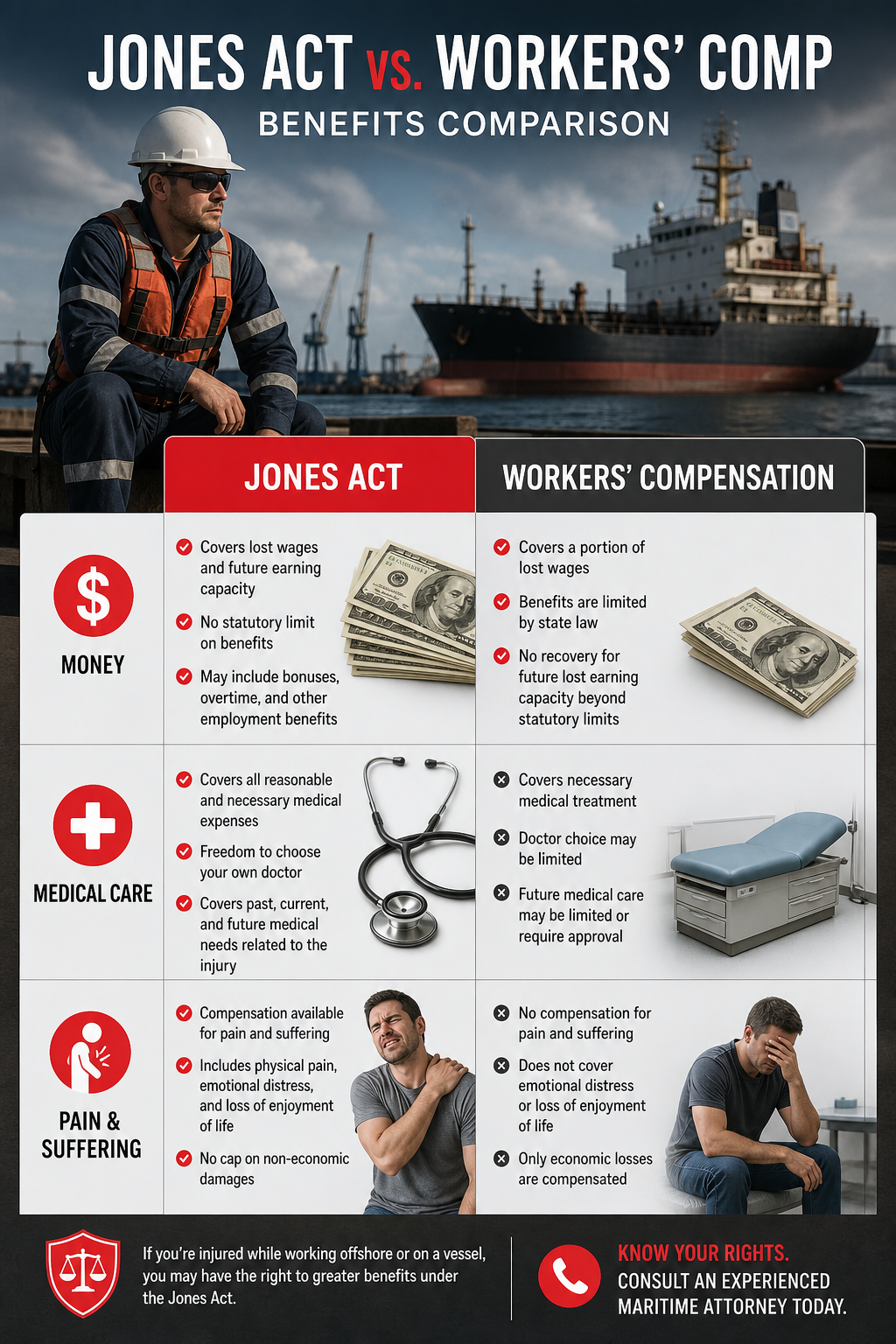
When an injury occurs, the type of benefits you can receive depends heavily on which system applies. Below is a side‑by‑side look at the core elements of each.
Notice how the Jones Act can offer “unlimited” compensation, while workers' comp caps most payments. That unlimited potential often makes a Jones Act claim more attractive for severe injuries.
But there’s a catch: the Jones Act requires proof of employer negligence or vessel unseaworthiness. Workers' comp, by contrast, is no‑fault, you don’t need to show anyone was at fault.
According to Jones Act Law’s maintenance‑vs‑cure overview, maintenance and cure provide a daily living allowance and medical care until maximum medical improvement, which can overlap with workers' comp for certain longshore workers.
Filing a Claim
Starting a claim can feel like a maze, but breaking it into clear steps helps keep the process moving.
First, report the injury immediately to your captain or supervisor. Get written documentation of the incident, including dates, witnesses, and any safety violations you observed.
Second, seek prompt medical treatment. Keep every bill, discharge summary, and doctor’s note. Those records become the backbone of your claim.
Third, decide which path to pursue. If you meet the seaman test, you can file a Jones Act lawsuit in federal court. If not, you’ll likely file a workers' comp claim with the state agency that covers maritime workers.
When you choose the Jones Act route, you’ll need to draft a complaint that outlines the employer’s negligence, perhaps a failure to maintain safety equipment or inadequate training. The complaint is filed in the U.S. District Court for the district where the injury occurred.
Workers' comp claims start with a claim form filed with the state’s workers' comp board. You’ll attach medical records and a description of how the injury happened on the job.
The timeline matters. A Jones Act claim must be filed within three years of the injury, per 46 U.S.C. § 30106. Workers' comp deadlines vary by state but are often shorter.
For a step‑by‑step walkthrough of the Jones Act filing process, see Southern Injury’s maritime injury guide. It explains the paperwork, the statute of limitations, and the role of a lawyer.
Common Injuries and Recoverable Damages
Maritime work brings unique hazards. Slip‑and‑fall accidents on wet decks, crushing injuries from cargo, and exposure to hazardous chemicals are among the most frequent.
Here are three common injury types and the damages they can generate under each system.
- Back injuries from heavy lifting:Jones Act can cover medical costs, lost wages, and pain‑and‑suffering. Workers' comp will pay medical bills and a portion of lost wages, but no pain‑and‑suffering.
- Burns from engine explosions:Both systems cover medical care, but the Jones Act adds compensation for disfigurement and emotional distress.
- Hearing loss due to engine noise:Jones Act can award future earning loss if the injury limits your ability to work long‑term; workers' comp provides a set disability benefit.

When calculating recoverable damages, the Jones Act looks at the full economic impact, future earnings, loss of career advancement, and even the cost of a new career path if you can’t return to the sea.
Workers' comp, however, follows a schedule of benefits set by the state. That schedule may cap the total amount you can receive for a specific injury, regardless of how severe the long‑term effects are.
Legal Considerations and Choosing the Right Path
Before you decide which route to take, weigh the legal hurdles. The Jones Act demands proof of negligence or unseaworthiness, which can be complex and may require expert testimony.
Workers' comp is simpler: you just need to prove the injury happened on the job. The trade‑off is a lower payout.
If you’re close to the 30 % threshold, you might qualify for both. In that case, you can collect maintenance and cure (a no‑fault right) while you pursue a Jones Act claim for additional damages.
Statutes of limitation also play a big role. Missing the three‑year deadline for a Jones Act claim usually means you lose the right to sue, while workers' comp deadlines differ by state and can be as short as 90 days.
Because the legal landscape is nuanced, many injured seamen turn to a specialized maritime attorney. An attorney can help you gather evidence, handle the filing timeline, and argue the seaman status if the insurer disputes it.
For a concise rundown of the three‑year federal deadline, see On My Side’s FAQ on the Jones Act statute of limitations. It explains exceptions, such as when injuries are discovered later.
Need help deciding which claim fits you? Check out Offshore Accident Attorney Guide: Protect Your Rights After a Maritime Incident. It outlines the differences between the Jones Act, the Longshore and Harbor Workers’ Compensation Act, and state workers' comp.
Frequently Asked Questions
What qualifies a worker as a “seaman” under the Jones Act?
A seaman must work on a vessel that is capable of moving under its own power, on navigable waters, and spend at least 30 % of their total employment time on that vessel or fleet. The duties must also contribute to the vessel’s mission, such as operating equipment, handling, or maintaining the ship.
Can I claim both the Jones Act and workers' compensation for the same injury?
Yes, in some cases you can receive maintenance and cure (a no‑fault maritime right) while also pursuing a Jones Act claim for additional damages like pain‑and‑suffering. However, workers' comp benefits may be reduced by the amount recovered under the Jones Act, depending on state law.
How long do I have to file a Jones Act lawsuit?
The federal statute of limitations is three years from the date of injury. If you didn’t know about the injury until later, the clock may start when you discovered the injury, but it’s safest to file as soon as possible.
What types of damages can I recover under workers' compensation?
Workers' comp typically covers medical expenses, a portion of lost wages (often 66‑80 % of your regular pay), and sometimes vocational rehabilitation. It does not cover pain‑and‑suffering or punitive damages.
Is proof of negligence required for a workers' compensation claim?
No. Workers' compensation is a no‑fault system, meaning you receive benefits regardless of who caused the injury, as long as it happened while you were performing job duties.
What evidence do I need to prove employer negligence for a Jones Act claim?
You’ll need documentation of the unsafe condition (photos, maintenance logs), witness statements, and expert testimony linking the employer’s failure to the injury. Medical records that show the injury’s severity also strengthen the case.
Can I sue my employer for unseaworthiness instead of negligence?
Yes. Unseaworthiness is a strict liability claim under general maritime law. If the vessel itself was unsafe, say, a broken rail or faulty engine, you can sue even without proving the employer’s direct negligence.
Do I need a lawyer to file a Jones Act claim?
While you can file on your own, the Jones Act involves complex legal standards and a higher burden of proof. An experienced maritime attorney can increase the chance of a successful outcome and help you avoid missed deadlines.
Conclusion
Understanding the split between the Jones Act and workers' compensation is the first step toward getting the right compensation after a maritime injury. The Jones Act offers broader recovery, pain‑and‑suffering, full lost wages, and even punitive damages, if you meet the seaman test and can prove negligence or unseaworthiness. Workers' compensation provides a safety net for all employees, delivering quick medical care and wage replacement without the need to prove fault, but it caps the amount you can receive.
Take action now: gather your work logs, document the injury, and talk to a maritime lawyer before the three‑year deadline expires. The sooner you act, the better your chance of preserving evidence and securing the benefits you deserve.
Ready to protect your rights and get the compensation you need?Start your free consultation today →