How to Follow Offshore Worker Safety Regulations

Offshore safety rules can come from more than one agency, law, or technical standard. A missed rule can affect a worker's life, an operator's permit, and the outcome of an inspection. Follow the process below to identify the rules, map them to tasks, control hazards, verify crew readiness, and keep proof that the work was done.
Step 1: Identify Which Offshore Safety Rules Apply
Start by defining the site, vessel, work, and people covered by your safety plan. Offshore worker safety regulations depend on the facility's location and the type of operation.
Write down the answers to these questions before you search for rules:
- Where is the installation located?
- Is it on the outer continental shelf, in territorial waters, or under another country's control?
- Does the work involve oil, gas, sulphur, renewable energy, drilling, construction, transport, or maintenance?
- Are workers employees, contractors, vessel crew, visitors, or temporary specialists?
- Will helicopters, support vessels, diving teams, or aircraft take part?
For a United States operation, begin with the federal agency that has authority over the activity. The National Academies explains that the Outer Continental Shelf Lands Act gave the United States Coast Guard a leading role in worker safety for offshore oil and gas production. Offshore renewable energy brings a different split of duties, with the Department of the Interior managing parts of that program while the Coast Guard remains involved in marine safety.
That distinction matters on a mixed project. A wind installation may need one set of rules for marine transfers and another for construction or energy work. An oil platform may face Bureau of Safety and Environmental Enforcement requirements alongside vessel rules and other federal duties. The site owner should name the lead regulator and then list every agency with a possible role. The National Academies overview of offshore safety jurisdiction explains this agency structure in more detail.
Do not assume the contractor's home state controls the whole job. Check the law tied to the worksite, the flag of any vessel, the port of departure, and the contract. Then ask counsel or a qualified compliance lead to resolve overlaps before workers go offshore. maritimeattorney.ai can help teams frame the legal questions when worker status, vessel duties, or overlapping maritime rules are unclear.
Step 2: Build a Compliance Map for Laws and Standards
Turn the rules into a compliance map that links each requirement to a person, task, record, and review date. This is the working core of your offshore worker safety regulations program.
Do not keep the map as a long list of legal citations. A supervisor needs to know what to check before a lift, hot-work job, confined-space entry, or crew transfer. Put each requirement into plain language and assign one owner.
For U.S. oil and gas operations, review the current BSEE regulations, guidance, Notices to Lessees and Operators, and Potential Incident of Noncompliance checklist items. Blines draw inspection items from safety and environmental regulations. It also explains that incorporated standards can have the force of law when the regulation adopts them by reference. Read the actual rule and referenced standard, not only a summary.
The BSEE regulations and standards page is a useful starting point for that review. Check it when the project changes, a rule is updated, or an incident reveals a gap.
Give every row a status such as open, verified, overdue, or not applicable. “Not applicable” needs a reason. Otherwise, it becomes an easy way to hide an unanswered question.
Set a change trigger. A new contractor, altered process, new chemical, major repair, weather limit, or regulator notice should reopen the map. The map should also record the version of each standard used. That small detail helps when a reviewer asks why a decision was made months later.
Step 3: Assess Offshore Hazards and Apply Controls
Use a task-based risk review to connect offshore worker safety regulations with the conditions crews face on the deck, platform, vessel, or aircraft.
Start with the job, not a generic hazard list. Break the work into steps. Ask what can harm a person at each stage, who may be exposed, and what changes when weather, lighting, fatigue, or equipment condition shifts.
Common offshore hazards include:
- Falls from height or overboard.
- Moving machinery, suspended loads, and dropped objects.
- Fire, explosion, or release of hydrocarbons.
- Confined spaces and oxygen-deficient atmospheres.
- Electrical, hydraulic, pneumatic, and stored energy.
- Hot work, chemical exposure, and high-pressure cleaning.
- Helicopter or vessel transfers.
- Severe weather, waves, ice, poor visibility, and fatigue.
Use the control hierarchy. First remove the hazard if the task can be changed. Next use a safer design or physical guard. Then add procedures, permits, alarms, and supervision. Personal protective equipment comes last, though it remains necessary when other controls cannot remove the risk.
Canadian offshore regulations give useful examples of the detail a hazard review may need. They define hot work as activity that uses or may produce fire, sparks, or another ignition source. They also treat a confined space as a place where the atmosphere or layout can make entry, rescue, or first aid difficult. These definitions show why a task name alone is not enough. “Tank cleaning” needs an atmosphere test, isolation plan, entry control, rescue method, and trained team.
For each high-risk task, record the trigger that stops the job. A crane lift may stop when wind passes the equipment limit. A transfer may stop when wave conditions exceed the approved threshold. A confined-space entry may stop when gas readings change or the attendant loses communication. Workers must know these limits before the task begins.
Ask the crew to review the risk assessment during the toolbox talk. If the actual work differs from the written plan, stop and revise it. A signed form cannot control a hazard that the team never discussed.
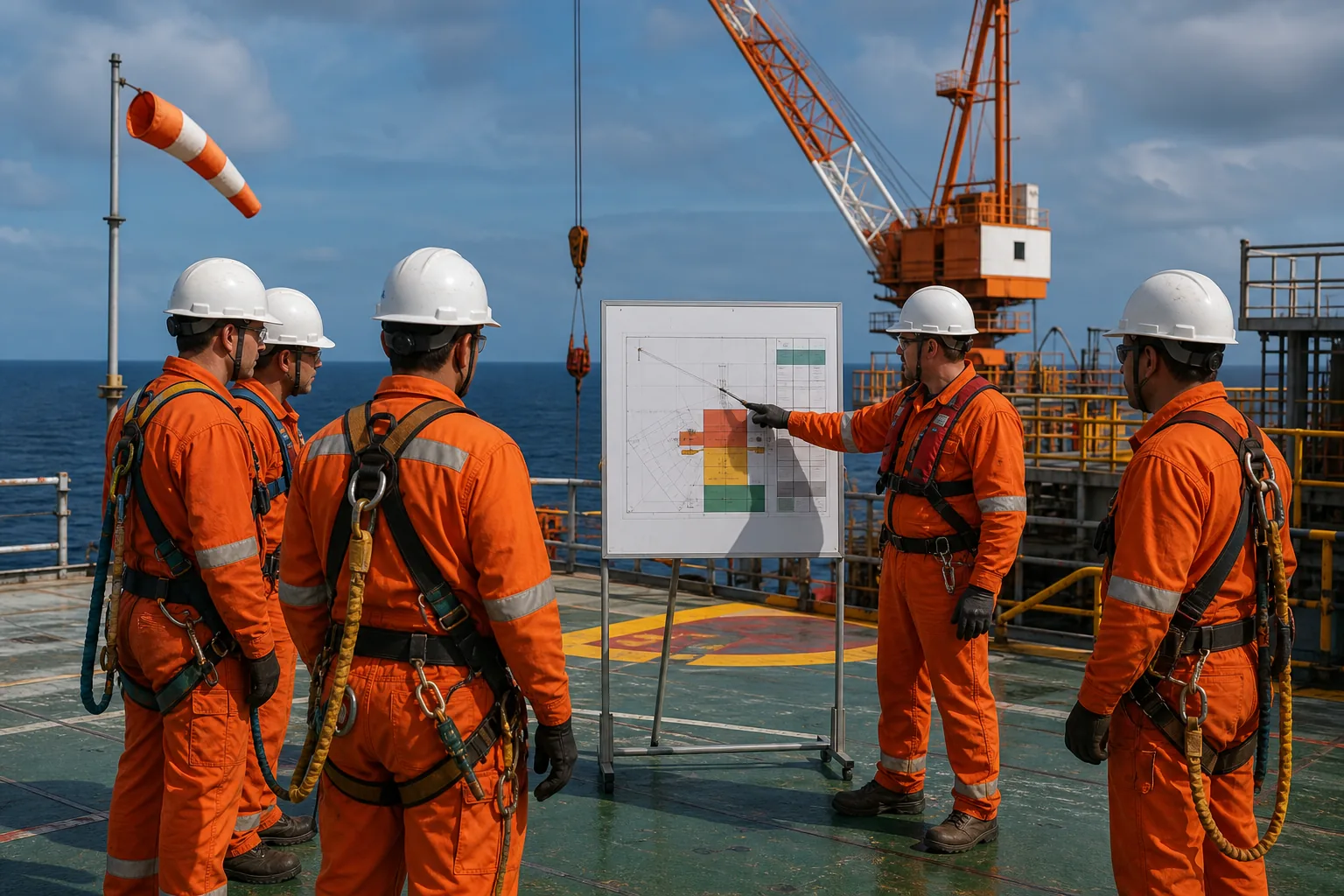
Use one clear permit for each high-risk job. Link it to the isolation record, gas test, lift plan, or rescue plan as needed. This makes the control chain visible when a shift changes or a contractor takes over.
Step 4: Verify Training, PPE, Medical Fitness, and Emergency Readiness
Training and emergency readiness turn offshore worker safety regulations into actions people can perform under pressure. Verify them before deployment, not after an incident.
Build a role-based training matrix. A crane operator needs different proof from a medic, electrician, rigger, diver, or person assigned to a confined-space team. List the task, required course, certificate expiry, practical assessment, and approving person.
Check more than a certificate number. Confirm that the course matches the task and the governing rule. The Canada-Nova Scotia offshore regulations, for example, define a competent person by knowledge, training, experience, and knowledge of the rules and hazards tied to the task. That is a stronger test than attendance alone.
Review PPE at the worksite. Check fit, condition, compatibility, storage, and replacement. A worker may need a lifejacket for one task, fall protection for another, and respiratory protection for a third. The supervisor should confirm that the selected gear works with the other gear and does not block communication or rescue.
Medical fitness needs the same care. Use the standard that applies to the worker's role and location. Keep health information private, while giving the deployment team a clear fitness status and any work limits they must follow.
Test emergency plans through drills that match actual conditions. A useful drill should show how the alarm starts, who gives the order, where people muster, how the team accounts for personnel, and how rescue reaches the casualty. Change the scenario sometimes. A night drill, blocked route, lost radio, or bad-weather exercise can expose weak points that a perfect daytime drill misses.
Review drill results with the crew. Assign each gap to a named person with a due date. Then test the fix. If a muster count failed because contractor lists were out of date, update the sign-in process and repeat the count on the next shift.
For broader maritime safety planning, the maritime safety regulations guide on maritimeattorney.ai can help place vessel duties and offshore work in the same review.
A person who cannot explain the emergency response in plain words is not ready for that assignment. Give the worker more instruction, practice, or supervision before departure.
Step 5: Document Compliance and Prepare for Inspections
Good records let you show how offshore worker safety regulations were applied on a real shift. They also help you find weak controls before an inspector does.
Keep records close to the task. A permit should connect to the job risk assessment, isolation, equipment check, names of the crew, and closeout. A training record should connect to the role and current assignment. An inspection record should show the defect, interim control, owner, due date, and closure evidence.
Use a document index with clear file names and revision dates. Remove old forms from active work areas. If workers can choose between three versions of a lifting checklist, the system has already failed.
Before an inspection, sample records instead of checking only the newest files. Select a recent shift, a high-risk permit, a contractor file, an equipment inspection, and an emergency drill. Trace each item from the rule to the field action and back to the evidence.
Walk the site with the same questions an inspector may ask:
- Can the supervisor show the current procedure?
- Can the crew explain the main hazard and stop-work limit?
- Can you prove the equipment was inspected?
- Can you account for every person offshore?
- Can you show that past findings were closed?
Never backfill a record from memory. If a check was missed, record the gap, assess the risk, and apply a corrective action. A late honest entry is safer than a false record.
Digital systems can help with version control, reminders, and audit trails, but they do not replace field checks. maritimeattorney.ai may be a useful legal review point when an inspection finding involves worker status, reporting duties, evidence, or possible liability. Keep the operational record factual. Do not add legal conclusions to a shift form.
Close every finding with evidence that another person can verify. That might be a new guard in place, a completed drill, a revised permit, or a maintenance test. A manager's signature alone does not prove that the hazard was fixed.
FAQ: Offshore Worker Safety Regulations
What are offshore worker safety regulations?
Offshore worker safety regulations are the laws, agency rules, permits, and adopted technical standards that protect people working at sea. The exact rules depend on the country, worksite, vessel, energy source, and task. A strong compliance plan identifies the authority first, then maps each rule to a hazard control, trained worker, and retained record.
Who regulates offshore worker safety in the United States?
Several agencies may have a role, so there is no single answer for every offshore job. The Coast Guard has a leading role in some oil and gas activities on the outer continental shelf, while BSEE regulates and enforces requirements for offshore oil, gas, and sulphur operations. Other work may involve different federal or state authorities.
What safety documents should an offshore employer keep?
An offshore employer should keep the records needed to prove each control was used. Typical files include risk assessments, permits, training records, medical fitness status, PPE checks, equipment inspections, maintenance records, drills, incident reports, and corrective actions. The records should show dates, responsible people, revisions, and closure evidence rather than only a signature.
How often should offshore safety training be renewed?
Renewal timing depends on the governing rule, role, course, employer program, and certificate terms. Do not use one blanket date for every worker. Track each qualification in a role-based matrix, check it before deployment, and repeat usable drills when conditions or equipment change. New hazards may require training even when a certificate remains valid.
Can a maritime attorney help with offshore safety compliance?
Yes, a maritime attorney can help identify legal duties, review jurisdiction questions, assess inspection findings, and protect evidence after an incident. Legal review does not replace a competent safety program or field supervision. If a worker is injured, early advice can also help preserve records and clarify which maritime law protections may apply.
Conclusion
Make one person accountable for the compliance map, then review it whenever the site, task, contractor, or rule changes. If the legal duties or worker protections are unclear, maritimeattorney.ai can provide a focused place to begin that review.