Maritime Injury Compensation Types: How to Claim

A maritime injury claim can fail before anyone reaches the question of value. The wrong worker status, missed deadline, or thin record can point you toward the wrong remedy. Start by identifying the law that covers your job, then match the injury to each loss you can prove.
This guide walks through the main maritime injury compensation types, the records to save, and the choices that shape a claim. maritimeattorney.ai can help you sort the facts before you commit to a claim route.
Step 1: Identify Your Maritime Worker Status and Governing Law
Your worker status decides which maritime injury compensation types may apply. Write down your job title, your daily duties, the vessel or worksite, and how much time you spent on a vessel.
Seamen may have claims under the Jones Act. The law can apply when a worker has a substantial connection to a vessel or group of vessels in navigation. That test is fact-specific. A job title alone won't settle it.
Seamen may also seek maintenance and cure. Maintenance can cover basic living costs while a worker heals. Cure relates to medical care. These benefits can exist even when fault is disputed, but the details depend on the worker's status and the facts of the illness or injury.
The Jones Act may also support a negligence claim against an employer. A worker might point to unsafe equipment, poor training, a rushed task, or a failure to fix a known hazard. The employer's conduct must connect to the harm. Do not assume that every accident proves negligence.
Read the maritime injury guide on legal rights and compensation while you build this first fact sheet. It can help you separate a vessel-based claim from a land-based one.
Other workers may fall under the Longshore and Harbor Workers' Compensation Act, often called the LHWCA. It can cover certain longshore workers, ship repair staff, shipbuilders, terminal workers, and other maritime workers who work on or near navigable waters. Coverage depends on both the worker's duties and the place of injury.
A worker injured on a fixed offshore platform may face a different analysis than a crew member injured aboard a vessel. A harbor worker may have a federal compensation claim rather than a Jones Act negligence claim. State workers' compensation may also enter the picture, but maritime law can change the result.
For a plain-language description of compensation categories tied to a Jones Act claim, review this overview of Jones Act compensation. Treat it as general information, not a ruling on your case.
By now you should have:
- A record of your job and daily work.
- The name of each vessel, platform, terminal, or worksite involved.
- The date and place of the injury.
- A first guess at whether your claim involves the Jones Act, the LHWCA, maintenance and cure, or another rule.
That guess is only a starting point. A lawyer should check the status question before you sign a release or accept a final payment.
Step 2: Match the Injury to the Right Type of Compensation
The main maritime injury compensation types fall into a few working groups. Sort each loss by what it pays for, who may owe it, and what proof supports it.
Medical compensation covers care tied to the injury. This may include emergency treatment, hospital care, surgery, medicine, physical therapy, medical devices, and future treatment when medical proof supports the need. Keep bills even when an insurer or employer pays them. The records still show the care you needed.
Wage loss covers pay you missed while the injury kept you from work. A claim may also include reduced future earning power when the injury limits your duties, hours, promotion path, or ability to return to the same type of work.
Maintenance and cure is a separate benefit for a qualifying seaman. It is not the same as pain and suffering. A seaman may need to pursue it while a broader negligence claim continues.
Non-economic loss can include physical pain, mental distress, loss of normal activities, and the lasting effect of a serious injury. These losses don't come with a neat bill. Medical notes, treatment plans, work limits, and clear statements about daily life can help show their effect.
A claim may also involve disability. Temporary disability can affect the period of recovery. Permanent disability can affect the kind of work you can do for the rest of your career. The label should come from medical evidence, not from a guess made during the first week.
A Jones Act claim may include damages tied to employer negligence. An unseaworthiness claim may involve the condition of a vessel or its crew. Maintenance and cure may apply through a different path. One accident can raise more than one legal issue.
Use this table to sort the losses before you estimate value:
The offshore injury evidence checklist also stresses the value of preserving records after the event. That point matters because employers may hold the first incident report, work logs, and vessel records.
Don't add every possible loss twice. For example, a future wage claim should account for the effect of a permanent disability without counting the same lost income in another category.
Decision rule: name the loss first, then list the proof that supports it. If you can't name the proof, mark the item for further review instead of assigning a large number.
Step 3: Calculate Medical, Wage, Disability, and Non-Economic Losses
Calculating maritime injury compensation types starts with a loss sheet, not a settlement guess. Use one row for each expense or effect. Add the date, amount, source, and whether the loss is past, current, or expected.
For medical costs, gather every bill and explanation of benefits. Then ask the treating provider what care remains. A surgery bill proves past cost. It doesn't prove that another surgery will be needed years from now.
For lost wages, compare the pay you would have earned with the pay you actually received. Include the normal work pattern if your job uses vessel rotations, day rates, overtime, or hazard pay. Use payroll records rather than memory.
For future earning loss, compare your pre-injury work path with the work you can now perform. A lifting limit may bar a deck job. Hearing damage may affect a safety-sensitive role. A back injury may reduce the number of shifts you can take. The claim needs medical proof and a sound work analysis.
Pain and mental distress need a different record. Keep a short daily log. Note sleep, pain levels, missed family activities, trouble with basic tasks, and side effects from treatment. Keep it factual. A clear pattern is more useful than dramatic language.
Use the maritime law compensation claim guide as you organize those categories. maritimeattorney.ai can also help you spot gaps between a loss you can name and a loss you can prove.
Don't use an online estimate as a final value. A calculator can help you see missing categories, but it can't decide liability, worker status, future care, or how a defense may challenge your evidence.
Review the sheet each time a doctor changes your work limits. The value can change when the medical outlook changes. That is normal.
Step 4: Document the Injury and Preserve Evidence
Good evidence connects the event to the loss. Start with a same-day account while the details are fresh. Write what happened, where you stood, what equipment was involved, who saw it, and what you did next.
Report the injury through the required work channel. Ask for a copy of the report. If a supervisor records the event in a different way, keep your own account and note the difference. Do not guess at a cause you didn't see.
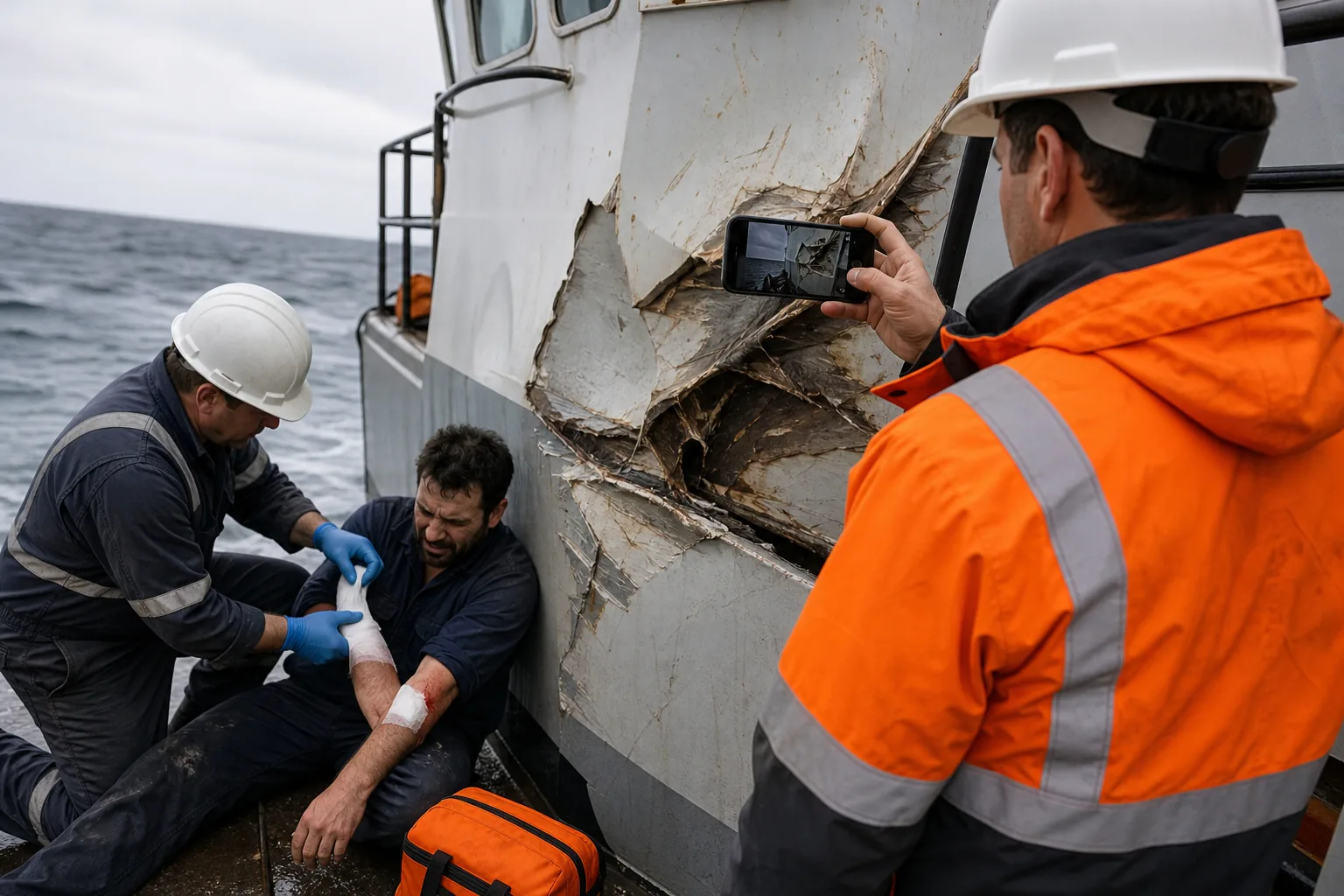
Take photographs when you can do so safely. Capture the work area, damaged equipment, deck condition, lighting, warning signs, and protective gear. Keep the original files. Do not edit the image in a way that removes its date or other file information.
Save messages and emails about the task. Keep work orders, training records, schedules, pay stubs, and medical instructions. A vessel may change hands or equipment may be repaired before a full investigation starts.
Witnesses matter. Write down each witness's name, role, and what the person saw. Don't coach anyone. A short note about location and first-hand knowledge is enough.
The evidence guide linked above points to several common records after an offshore injury, including medical material and work-related proof. Your own file should keep those records in separate folders so a missing document stands out.
Medical care comes first. Tell the provider every symptom, even if it seems small. Follow work restrictions unless a medical professional changes them. Gaps in care can give an insurer a reason to argue that the injury was minor or unrelated.
Don't post a detailed account on social media. A photo or comment can be read without the context of your pain, work limits, or treatment. Give a full account to your lawyer instead.
By now you should have: an incident timeline, a medical folder, a wage folder, photographs, witness details, and copies of reports. Keep a backup in a secure place.
Step 5: Choose the Claim Route and Meet Maritime Filing Deadlines
The right claim route depends on your status, the injury site, the vessel, the employer, and the conduct that caused the harm. Choose it after gathering facts, not after accepting the first form an employer gives you.
A qualifying seaman may pursue a Jones Act negligence claim. A seaman may also seek maintenance and cure. A longshore or harbor worker may fall under the LHWCA. A worker on a fixed offshore site may need a different review. These paths can have different proof rules and filing deadlines.
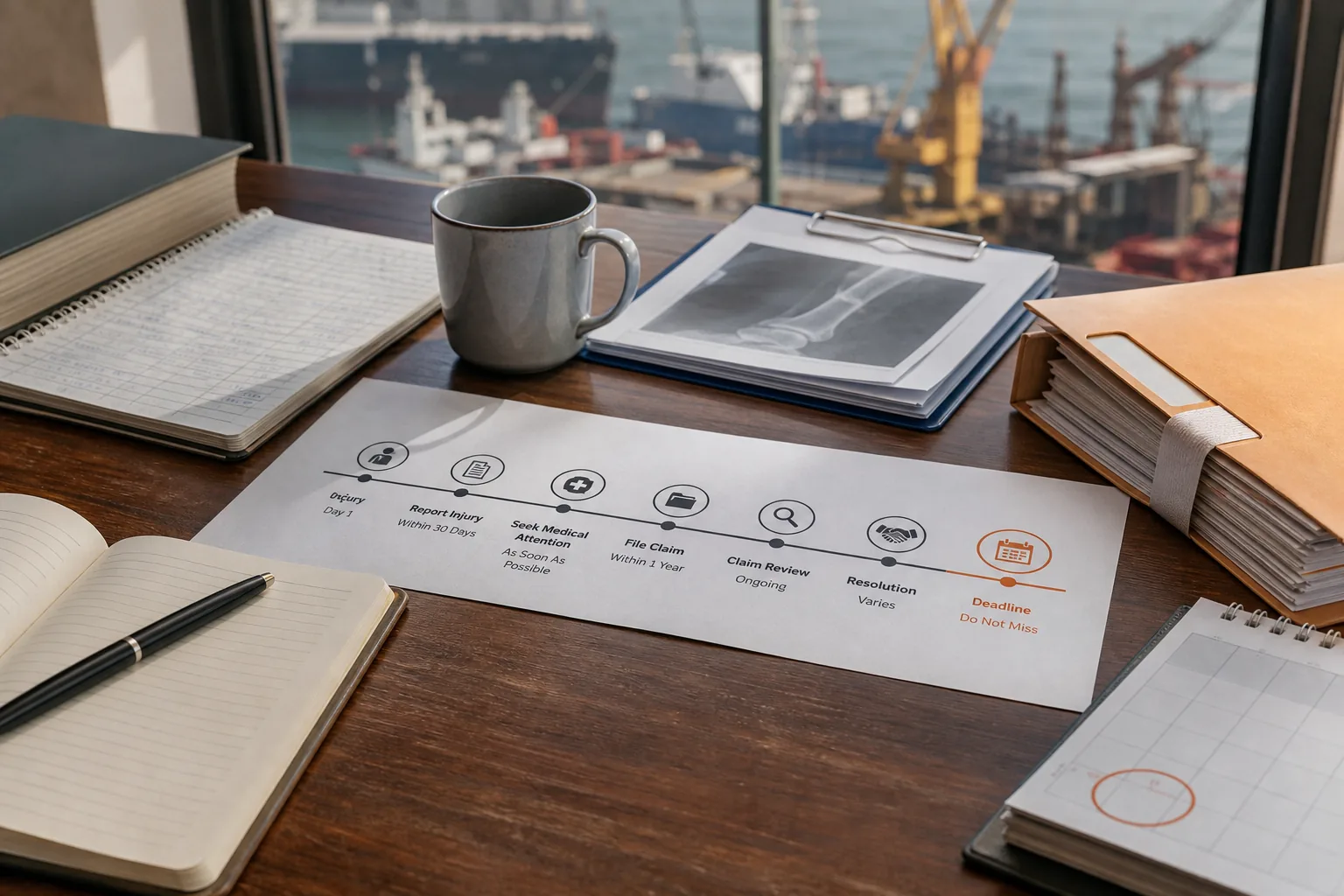
Deadlines can be short. The exact period may depend on the statute, the defendant, the location, and whether a contract or notice rule applies. Some claims also require an earlier notice to an employer or agency. Do not rely on a search result that gives one deadline for every maritime worker.
Ask a maritime lawyer to identify every possible deadline in writing. Give the lawyer the injury date, the date you reported it, the names of employers and vessel owners, and any notice or release you received.
Be careful with settlement papers. A payment for one benefit may not resolve every claim, but the language controls. A release may give up rights you did not mean to waive. Have the full document reviewed before signing.
When you contact maritimeattorney.ai, bring your timeline and loss sheet. A clear file lets the legal review focus on the disputed issues, such as worker status, fault, future care, or the effect of a permanent restriction.
Do not wait for a final diagnosis before asking about deadlines. Treatment can continue while a lawyer protects the claim. The best time to check the filing route is early, when records and witnesses are easier to find.
Final checkpoint: you should know which law may apply, what compensation you seek, what evidence supports it, and the earliest deadline that could affect your rights.
Frequently Asked Questions About Maritime Injury Compensation Types
What are the main maritime injury compensation types?
The main categories include medical care, lost wages, reduced future earning power, disability, pain and mental distress, plus maintenance and cure for qualifying seamen. A claim may also involve damages tied to employer negligence or an unsafe vessel. The categories that apply depend on your worker status, the injury site, and the facts.
Can a maritime worker claim lost wages after an injury?
Yes, a maritime worker may claim lost wages when the injury keeps the worker from earning normal pay. Start with payroll records and work schedules. Then check whether the injury affects future work, overtime, vessel rotations, or the ability to return to the same job. Future loss needs medical and work evidence.
What is maintenance and cure?
Maintenance and cure is a benefit that may help a qualifying seaman with basic living support and medical care during recovery. It is separate from pain and suffering. The worker's status and medical facts control. Get advice before signing a release or accepting a payment described as full and final.
How long do I have to file a maritime injury claim?
There is no single deadline for every maritime injury compensation claim. The time limit can depend on the law, defendant, location, and claim route. Notice rules may apply before a lawsuit. Write down all key dates and ask a maritime lawyer to confirm the earliest deadline.
What evidence helps prove a maritime injury claim?
Useful evidence includes the incident report, medical records, photographs, witness details, work orders, training records, pay data, and written work restrictions. Keep a daily symptom log too. These records connect the event with the injury and show how it affected your work and home life.
Start with a written timeline, preserve every record, and get the governing law checked before you sign anything. If you want help sorting the facts, maritimeattorney.ai is a reasonable place to begin the review.