
Maritime Injury Claim Deadline Calculator Guide

Got hurt on a ship, a dock, or a offshore platform? The clock on your claim starts ticking the moment the injury occurs, and missing the deadline can end your case forever. This guide walks you through the exact steps to feed a maritime injury claim deadline calculator, understand the result, and lock in the help you need.
Step 1: Gather the Dates and Facts the Calculator Needs
First, write down the date you were injured. That could be the day a slip on a gangway happened, the moment a fire broke out on a vessel, or when a crane dropped a load on you at a port. Next, note the type of accident, was it a collision, a fall, a burn, or a medical mistake? Finally, record where the incident took place: name of the ship or facility, the port city, and whether it was in U.S. waters or international waters.
These facts are the building blocks the calculator uses to match your situation to the right legal timeline. If you’re unsure about any detail, pull the vessel’s incident log, the crew’s daily report, or any medical records you received right after the injury. A clean list of dates and facts makes the next steps smoother.
Don’t forget to note any notices you already sent. Some cruise lines and employers require a written notice within a few months. If you have that document, keep it handy, the calculator will ask for it later.
Step 2: Identify Which Maritime Law May Apply
Maritime law isn’t one monolith. Your claim could fall under the Jones Act, the Longshore and Harbor Workers’ Compensation Act (LHWCA), general maritime negligence, or the Death on the High Seas Act (DOHSA). The distinction hinges on who you are and where you were working.
If you were a seaman or an offshore worker, the Jones Act is likely the right path. It lets you sue your employer for negligence and recover full damages. The Jones Act is limited to workers who spend at least 30% of their time on a vessel in navigation.
Dockworkers, terminal employees, and shipyard laborers often qualify for LHWCA benefits. The act provides medical care and wage replacement regardless of fault. Details on LHWCA can be found on its Wikipedia page.
Passengers and other non‑crew members usually pursue a general maritime negligence claim, which follows the same three‑element test as land‑based personal injury. Knowing which statute fits saves you from filing the wrong paperwork.
Step 3: Enter the Information and Read the Estimated Deadline
Open your chosen maritime injury claim deadline calculator. Most tools ask for the same core inputs: injury date, accident type, jurisdiction, and the legal theory you plan to use. Fill each field exactly as you recorded it in Step 1.
After you hit “calculate,” the tool spits out a date. That date is the last day you can file a lawsuit or a formal claim, depending on the law you selected. Below is a simple example of what a calculator might display.
| Input | Result |
|---|---|
| Injury Date | June 12 2026 |
| Law Applied | Jones Act |
| Jurisdiction | Florida (state‑based filing) |
| Calculated Deadline | June 12 2029 (3 years) |
If the calculator shows a deadline that seems shorter than the three‑year rule, double‑check any contract‑based notice periods. Cruise tickets, for example, can shrink the filing window to six months for notice and one year for suit.
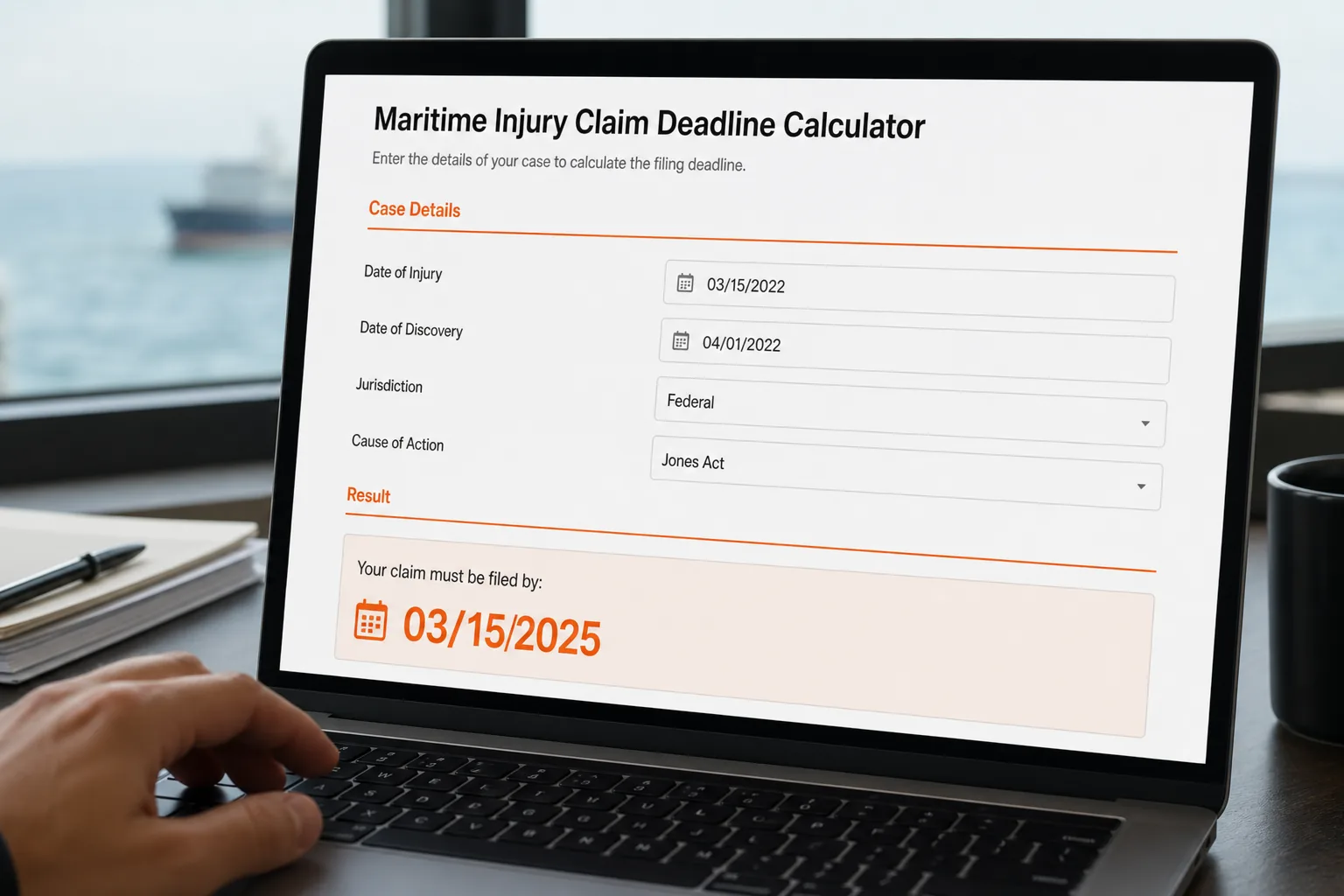
Write the deadline down in a safe place. Set a calendar reminder a month before it expires so you have time to gather evidence and talk to an attorney.
Step 4: Check Notice, Contract, and Administrative Deadlines
Many maritime employers and cruise lines embed notice requirements in their contracts. A common pattern is a six‑month written‑notice rule followed by a one‑year filing deadline. Federal law (46 U.S.C. § 30508a) lets carriers set those limits, and courts usually enforce them.
Locate the clause in your ticket, employment contract, or union agreement. If you can’t find it, request a copy from HR or the carrier’s legal department. Missing a notice deadline can nullify a claim even if the statute of limitations is still open.
Some claims also have administrative steps, such as filing a formal claim with the U.S. Department of Labor for LHWCA benefits. That filing must happen within one year of the injury, and you must give your employer written notice within 30 days.
Once you’ve confirmed the contract‑based dates line up with the calculator’s output, you’re ready to move forward.
Step 5: Verify the Result With a Maritime Injury Attorney
The calculator gives you an estimate, but only a qualified lawyer can confirm the exact deadline for your unique facts. An attorney will review the accident report, the contract language, and any discovery‑rule exceptions that might extend or pause the clock.
At this stage, reach out to a firm that specializes in maritime law. Maritime Attorney AI offers a free, confidential consultation and can run the same calculator on your behalf, then compare its result to the legal standards.
During the call, ask the lawyer to walk you through how the deadline was calculated, what evidence you still need, and any upcoming filing milestones. Getting a professional sign‑off prevents a costly mistake later on.
FAQ: Maritime Injury Claim Deadline Calculator
How does a deadline calculator know which law applies?
The tool asks for your job role, accident type, and location, then matches those answers to the statutes that govern each scenario, such as the Jones Act for seamen or LHWCA for dockworkers.
Can the deadline be extended after the injury?
In limited cases, a “discovery rule” or a tolling provision for minors can push the start date later, but you need a lawyer to prove the exception applies.
Do cruise‑ship ticket contracts really shorten the filing period?
Yes. Federal law allows carriers to require written notice within six months and a lawsuit within one year, and most major lines include those clauses.
What if I missed the notice deadline but still have time under the statute of limitations?
Missing a contractual notice often bars the claim outright, even if the statutory clock hasn’t run out. A court will likely dismiss the case.
Do I need a lawyer to use the calculator?
No, anyone can enter the facts. However, a lawyer can verify that the inputs are correct and that no hidden deadlines apply.
Is the three‑year limit the same everywhere?
Most federal maritime claims, including Jones Act and general maritime negligence, use a three‑year limit, but some states have shorter periods for specific types of injuries.
Getting the deadline right is the first line of defense for any maritime injury claim. Use the steps above, run the calculator, and then lock in expert legal help before the clock runs out.
Ready to put this into practice? maritimeattorney.ai was built for exactly this.