
How to File a Seaman Injury Claim

If you’ve been hurt while working on a vessel, you need a clear path to get the money you deserve. Below are the five steps you must take to file a seaman injury claim and protect your rights.
Step 1: Get Medical Care and Confirm Your Seaman Status
First, get professional medical treatment. Tell the doctor exactly how the injury happened on the ship. Prompt care protects your health and creates a record that the injury is work‑related.
Next, make sure you qualify as a seaman under the Jones Act. A seaman is someone who spends at least 30 % of their work time on a vessel that is capable of navigation and who contributes to the vessel’s mission. Nolo explains the seaman‑status test and gives examples of jobs that meet the rule.
If you work mainly on land or only visit a ship once a year, you likely won’t meet the threshold. But if you split your week between the office and the deck, you probably qualify.
While you’re in the hospital, ask the medical staff to note that you were on duty aboard a vessel when the injury occurred. That note will be a key piece of evidence later.
Step 2: Report the Injury and Preserve Critical Evidence
Tell your captain or shipmaster about the incident right away. A written report creates a paper trail that the court will look at.
Collect evidence as soon as possible. Snap photos of the accident scene, the equipment involved, and any visible injuries. Ask coworkers for written statements about what they saw.
Gather employment records that show you spent enough time on the vessel. Logs, work schedules, and assignment rosters prove the 30 % rule. ELG Law lists the exact documents you’ll need. Keep a folder with copies of each item.
Do not give a recorded statement to your employer or its insurer until you have spoken with a maritime lawyer. Anything you say can be used to cut your recovery.
Step 3: Identify the Legal Basis and Calculate Filing Deadlines
Decide whether the Jones Act or general maritime law applies. The Jones Act lets a qualifying seaman sue for negligence. General maritime law covers a broader group of workers and can add claims for unseaworthiness or maintenance‑and‑cure.
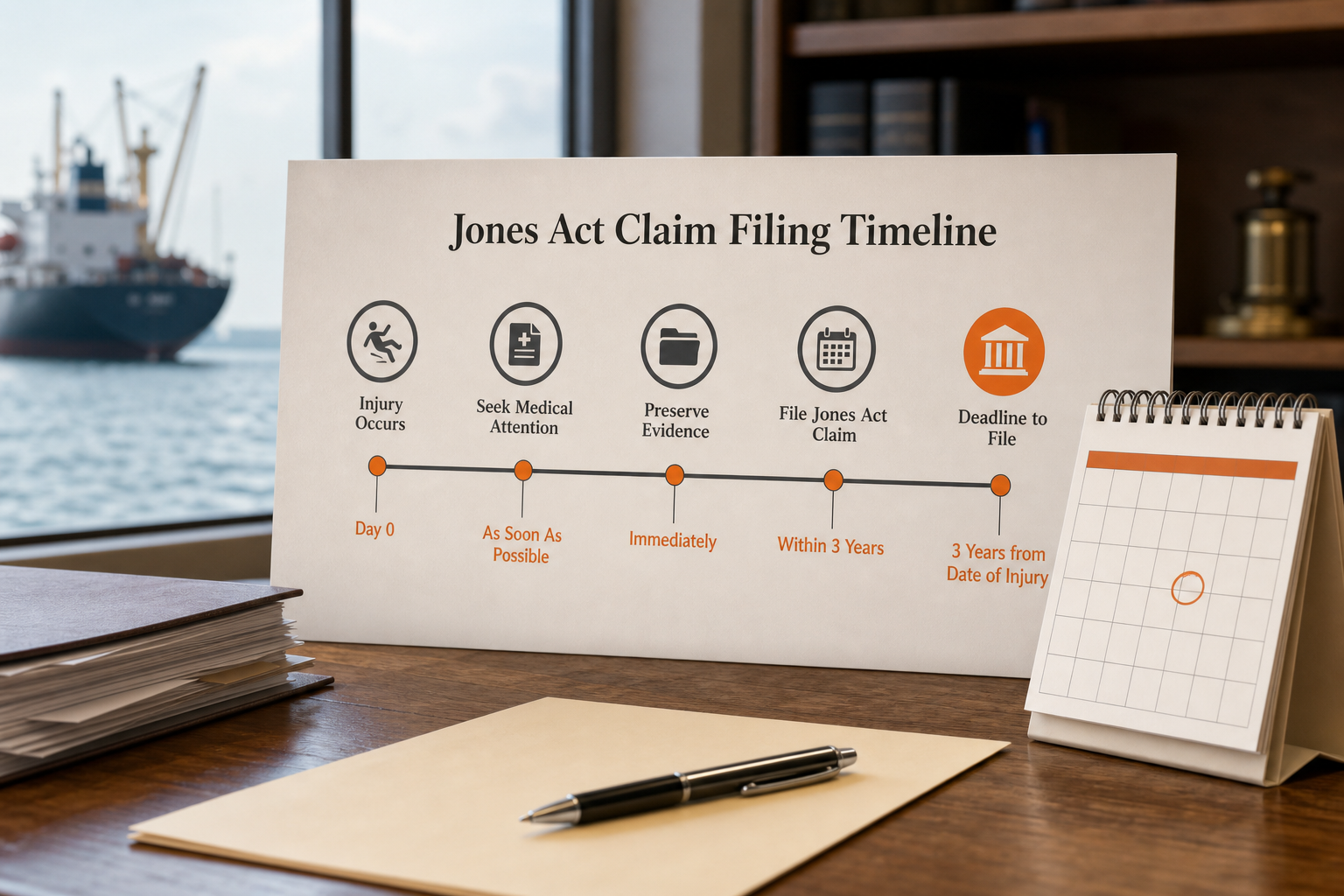
Both legal tracks are governed by federal statutes, but the Jones Act has a strict three‑year filing deadline from the date of injury. Missing that deadline usually means you lose the right to sue.
Here is a quick timeline you can use to track key dates:
For a deeper look at the differences between the two legal bases, see Wikipedia’s Jones Act entry. It outlines the history, the “feather‑weight” causation standard, and the types of damages you can seek.
Step 4: Consult a Maritime Lawyer and Build the Claim
At this point, reach out to a lawyer who specializes in the Jones Act. A skilled attorney will review your evidence, verify your seaman status, and calculate the full value of your claim, including medical costs, lost wages, pain and suffering, and maintenance‑and‑cure.
Maritimeattorney.ai offers a free consultation and can walk you through the entire process. Their AI‑driven platform helps you organize documents, estimate damages, and connect with a vetted Jones Act attorney.
During the first meeting, expect the lawyer to ask for copies of your medical records, vessel logs, and employment documents. They will also explain how the “feather‑weight” causation standard works and why even a small slip by the employer can trigger liability.
Ask the lawyer about their experience with similar cases. A good attorney should have a track record of securing settlements or verdicts for seamen.
Step 5: Negotiate or File Suit Without Waiving Your Rights
Many ship owners try to settle quickly. While a settlement can give you money sooner, you must not sign away any rights you don’t fully understand.
Federal courts treat settlements with seamen carefully. If a release is signed without an “informed understanding” of maintenance‑and‑cure, unseaworthiness, and Jones Act claims, a judge can invalidate it. Marinelink explains the safeguards courts apply.
If you choose to negotiate, have your lawyer present a clear summary of damages and a deadline for the employer’s response. If the employer refuses a fair offer, the next step is to file a complaint in federal court.
Filing a suit starts with a complaint that lays out the facts, cites the Jones Act, and lists the damages you seek. Your attorney will handle the paperwork and manage discovery , the process of swapping evidence with the other side.
FAQ About Seaman Injury Claims
Do I have to be a certified seaman to file a claim?
No, you just need to meet the Jones Act’s 30 % rule. If you spend at least 30 % of your work time on a vessel that is capable of navigation, you qualify.
How long do I have to file a Jones Act claim?
You have three years from the date of injury. Missing that deadline usually bars the claim.
What compensation can I receive?
You can recover medical expenses, lost wages, maintenance‑and‑cure payments, pain and suffering, and possibly punitive damages if the employer acted in bad faith.
Can I file a claim without a lawyer?
You can, but the process is complex. Without legal help you risk missing deadlines, losing evidence, or signing a settlement that waives important rights.
What is maintenance and cure?
It’s a no‑fault benefit that covers daily living costs and all reasonable medical treatment while you’re unable to work, regardless of who caused the injury.
Do I need to prove my employer was negligent?
Yes, for a Jones Act claim you must show the employer’s negligence played any role in your injury. The standard is very low , even a tiny slip can be enough.
Ready to protect your rights? Start by gathering your medical records and vessel logs, then book a free consultation with maritimeattorney.ai. They’ll help you lock in the deadlines and build a solid claim.