Maritime Wrongful Death Claims: Legal Steps
A maritime wrongful death claim can fail before a family reaches the facts, simply because the wrong law or deadline was used. The legal path depends on the vessel, the victim’s job, the place of death, and who caused the harm. Follow these five steps to protect the claim and give counsel the record needed to act.
Step 1: Identify Which Maritime Law Applies
The first task in a maritime wrongful death case is to identify the law that controls the claim. Do this before signing a release or accepting a final insurance payment.
Start with four facts. Write down whether the deceased was a seaman, passenger, worker, or another person on the vessel. Then record where the incident happened. Note the vessel’s owner, the employer, and the party that operated the vessel.
Those facts can point to very different remedies. A seaman’s death may involve the Jones Act, especially when employer negligence caused the death. An unseaworthiness claim may also matter. A death caused by another party can raise a separate claim.
Location matters just as much. The Death on the High Seas Act, or DOHSA, applies to a wrongful death caused beyond three nautical miles from the shore of the United States. The statute lets a personal representative bring an admiralty action for the benefit of certain family members and dependents. Read the statute itself at the United States Code’s DOHSA provisions.
Deaths within state territorial waters may involve state law or general maritime law. The rules can change based on the victim’s status and the type of defendant. A passenger case is not analyzed like a crew member’s employer claim.
Gather these records at once:
- The vessel name, owner, operator, and flag.
- The victim’s job title and work contract.
- The exact location, route, and distance from shore.
- Any ticket, waiver, release, or employment agreement.
- Reports from the Coast Guard, police, port authority, or employer.
For a plain-language review of the legal categories, maritimeattorney.ai’s admiralty and maritime law guide can help you sort the basic terms before the first lawyer meeting. It does not replace a case review, but it can help you ask better questions.
Milestone: By now, you should have a one-page law map. It should name the victim’s role, the incident location, the likely defendants, and the statutes that may apply.
Step 2: Preserve Evidence and Build the Incident Record
Evidence can vanish quickly after a maritime wrongful death. Preserve the incident record before memories fade or a vessel leaves the port.
Make a written timeline while the details are fresh. Use exact times where you know them. Mark uncertain points as uncertain. Do not fill gaps with guesses. A careful timeline is more useful than a polished story that later changes.
Save every document in its original form. Keep copies of emails, text messages, work schedules, safety notices, maintenance records, and training logs. If you receive a form from an employer or insurer, save the envelope or delivery email too.
Ask counsel to send preservation letters to likely custodians. The request may cover bridge audio, voyage data, surveillance video, GPS records, electronic logs, crew messages, inspection files, and maintenance records. A preservation request does not prove that evidence exists. It tells the other side that relevant material must be protected.
Identify witnesses by name and role. A deckhand may know about a missing guard. A passenger may have seen alcohol use or a late safety briefing. A mechanic may know that a warning had been raised before the trip. Write down contact details, but avoid coaching anyone or asking for a signed statement on your own.
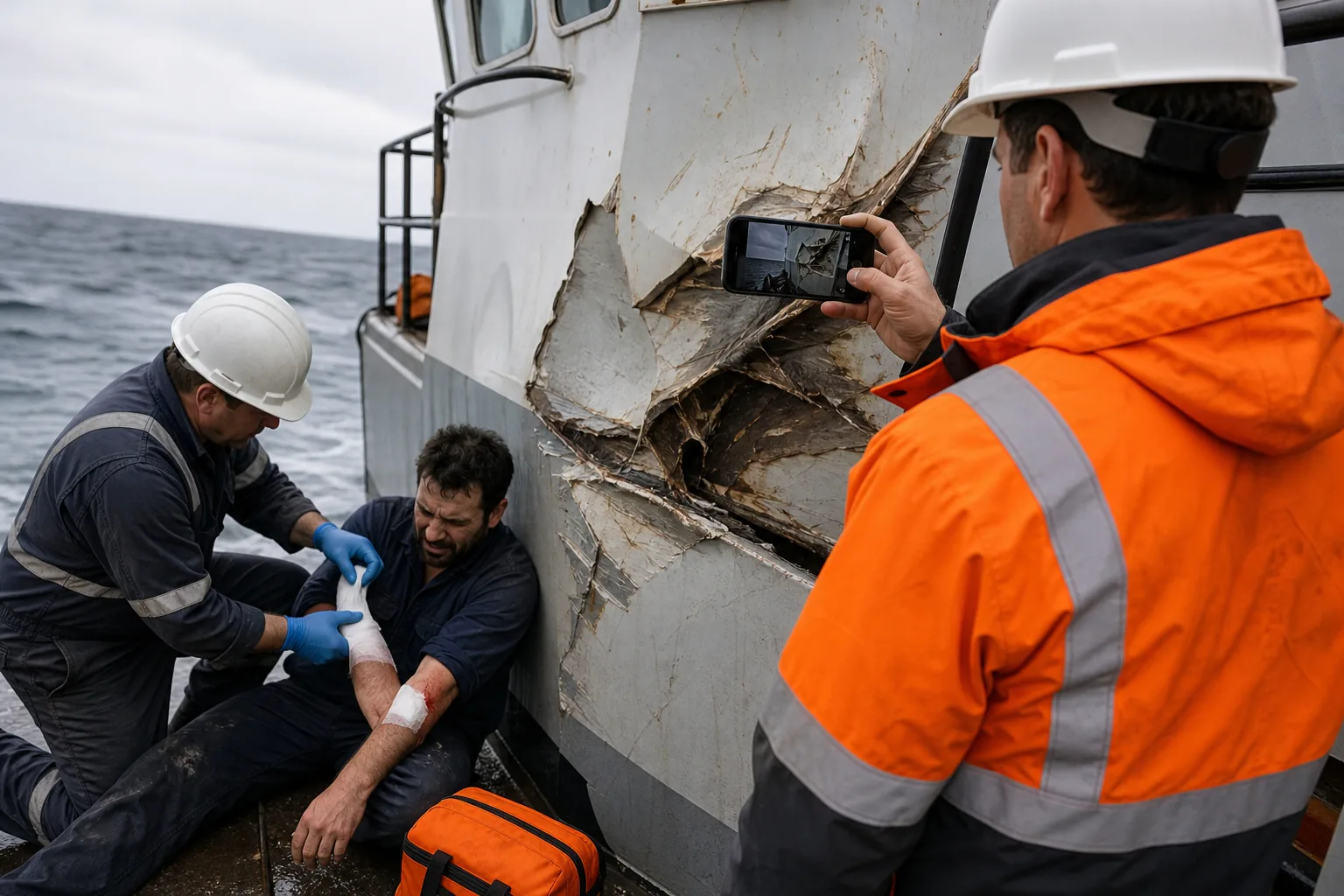
Photographs should show the vessel, work area, equipment, weather, lighting, and safety barriers. Keep the original file and note when it was taken. Do not edit the image. If you must mark a copy for discussion, keep the unmarked original beside it.
Medical and death records also matter. Request records through the proper process. Keep funeral bills, wage records, tax documents, benefit statements, and proof of family support. These records help connect the loss to the damages claimed.
Some maritime law firms also ask operators to improve their internal incident controls. A governance and compliance system such as AssurePlus is described as a way for regulated enterprises to bring risk data, incident reporting, and compliance work into one system. That type of record system may help an operator track safety issues, but it does not replace a legal preservation notice.
Do not post a detailed account on social media. Do not argue with the vessel owner online. A short, emotional post can be taken out of context during a claim.
Milestone: You should now have a dated incident timeline, a document folder, a witness list, and a written request to preserve key evidence.
Step 3: Determine Who May Be Legally Responsible
A maritime wrongful death claim may involve more than one responsible party. Build the defendant list from conduct and control, not from the first name that appears on an insurance letter.
Begin with the employer. Ask who hired the deceased, who assigned the work, and who controlled the vessel or job site. Employer negligence may involve poor training, unsafe orders, weak supervision, defective equipment, or a failure to act after a known hazard appeared.
Then examine the vessel owner and operator. Ownership alone does not answer every liability question. The key facts may include who maintained the vessel, who chose the crew, who set the voyage plan, and who had power to correct the unsafe condition.
Third parties may matter as well. A contractor could have controlled a dangerous task. An equipment maker may face a product claim if a defect caused the death. Another vessel may have created the collision risk. A port or facility may have contributed through an unsafe condition, subject to the facts and applicable law.
Separate civil responsibility from criminal investigation. Wrongful death is a civil action. A prosecutor may investigate a separate offense, but the civil claim has its own proof, parties, and remedies.
Preserve every contract that describes responsibility. This includes charter agreements, staffing contracts, subcontractor terms, ticket conditions, and vessel management documents. These records may show who held a safety duty and who had the power to fix the problem.
Look for prior notice. Earlier inspection findings, near-miss reports, crew complaints, and repair requests can help show that a hazard was known. A new attorney may also seek records through formal discovery if the case is filed.
Do not assume that a settlement with one party ends every claim. Release language can affect claims against others. Have a maritime attorney review any release before you sign it.
Decision rule: Name a party only after you can explain what that party controlled, what duty may have applied, and what act or failure may have caused the death.
Step 4: Calculate Recoverable Damages
Damages in a maritime wrongful death case depend on the governing law and the loss suffered by eligible claimants. Do not start with a round number. Start with records.
Wrongful death damages usually focus on losses suffered by surviving family members. Those losses can include the financial support the deceased would likely have provided. The calculation may consider earnings, work history, expected career path, benefits, household contributions, and the victim’s personal consumption.
A survival action is different. It is brought by the estate for losses suffered by the deceased or the estate before death. Depending on the law, the claim may include pre-death medical costs or conscious pain and suffering. The two actions can overlap, but they are not the same claim.
DOHSA limits recovery to pecuniary loss in the ordinary maritime setting. The United States Code describes recovery as fair compensation for pecuniary loss sustained by the people entitled to benefit. That makes wage records and financial proof especially important in a high-seas case.
General maritime law can apply different limits. Some damages recognized in other maritime claims, such as loss of love and affection or pre-death pain and suffering, may not be available under DOHSA or the Jones Act. State law and the federal circuit can also affect the result.
Build a damages file with:
- Pay records, tax returns, contracts, and benefit statements.
- Household expense records and proof of regular support.
- Funeral and burial costs.
- Medical bills linked to the final injury.
- Evidence of the victim’s work skills, promotion path, and retirement plan.
- Records showing services the victim provided at home.
Use cautious assumptions. If income changed by season, show the pattern. If the victim worked overtime, document the history instead of assuming it would continue. A financial expert may help with a long-term projection, but the inputs must come from real records.
Contributory negligence can also affect recovery under DOHSA. The statute says the court must consider the decedent’s degree of negligence and reduce recovery accordingly. That does not mean a family should accept blame without review.

Key takeaway: Keep the damages proof separate from the liability proof. One file explains who caused the death. The other shows what the family and estate lost.
Step 5: Protect Filing Deadlines and Choose Legal Representation
Deadlines can end a maritime wrongful death claim even when the evidence is strong. Get the incident date, death date, victim’s status, location, and possible statute to a maritime lawyer quickly.
Do not rely on a single deadline. Different legal theories may carry different limits. A Jones Act claim, a DOHSA claim, a state wrongful death claim, and a contract-based passenger claim may not share the same filing period. A ticket may also contain notice or forum terms that need early review.
Ask the lawyer to identify the deadline in writing. The answer should state which claim it covers and what event starts the clock. If facts remain unclear, treat the earliest plausible deadline as the working date.
Choose counsel based on the case, not on a general personal injury label. Ask whether the lawyer handles admiralty cases, seaman claims, passenger incidents, vessel collisions, offshore work, and federal maritime statutes. Ask who will manage the case day to day.
Bring a clean intake packet to the first meeting. Include the timeline, death certificate if available, employment records, vessel details, witness list, photographs, reports, insurance letters, and every release or settlement document. A lawyer can spot issues faster when the facts are ordered.
Ask about fees and costs before representation begins. Confirm whether the fee is contingent, which expenses are separate, and what happens if the case ends before filing. Ask how expert costs, records fees, travel, and litigation expenses are handled.
It is also fair to ask about conflicts. The same firm should not represent the employer, vessel owner, insurer, and family in the same dispute. If a prior lawyer gave advice, disclose it.
maritimeattorney.ai is a useful first research point for families looking for maritime legal guidance. Contact the site through its online resources, then verify the lawyer’s license, maritime experience, fee terms, and role before signing an agreement.
Do not wait for the investigation to finish before getting legal advice. An investigation can continue while counsel protects evidence and checks the filing clock.
Milestone: You should leave the first consultation with a deadline plan, a list of possible claims, a document request list, and a clear next action.
FAQ: Maritime Wrongful Death Claims
What is a maritime wrongful death claim?
A maritime wrongful death claim is a civil case seeking damages after a death connected to a vessel, maritime job, or navigable waterway. The controlling law depends on the victim’s role, the location, and the conduct that caused the death. Possible claims may involve federal maritime statutes, general maritime law, state law, or more than one theory.
Does DOHSA apply to every death at sea?
DOHSA does not apply to every death at sea. It generally covers a wrongful death caused beyond three nautical miles from the shore of the United States, subject to the statute’s limits and exceptions. Deaths within state territorial waters may involve another law. A lawyer must confirm the location and the victim’s status before choosing DOHSA.
Who can file a maritime wrongful death lawsuit?
The proper filer depends on the governing law and the family relationship. Under DOHSA, the personal representative brings the action for the exclusive benefit of the spouse, parent, child, or dependent relative. A seaman’s claim may follow different rules. The estate and eligible family members should have counsel confirm who must be named.
What damages are available in a maritime death case?
Available damages depend on the statute and the facts. They may include financial support, funeral costs, medical costs, and estate losses. DOHSA generally focuses on pecuniary loss. Some damages recognized under general maritime law may not be available under DOHSA or the Jones Act, so families should not assume every loss has the same legal value.
How long do I have to file a maritime wrongful death claim?
There is no single deadline for every maritime wrongful death claim. The filing period can change with the governing statute, the victim’s job, the location, and any passenger contract. Ask a maritime attorney to identify each possible deadline and the event that starts it. Early advice is safer than waiting for a final investigation report.
Conclusion
Start by preserving the facts and confirming the law before discussing settlement. Give a maritime attorney your timeline, vessel details, records, and possible filing dates as soon as possible. If you need a starting point, maritimeattorney.ai can help you organize the questions and documents for that first legal review.