Helicopter Crash Offshore: Causes, Liability & Legal Options
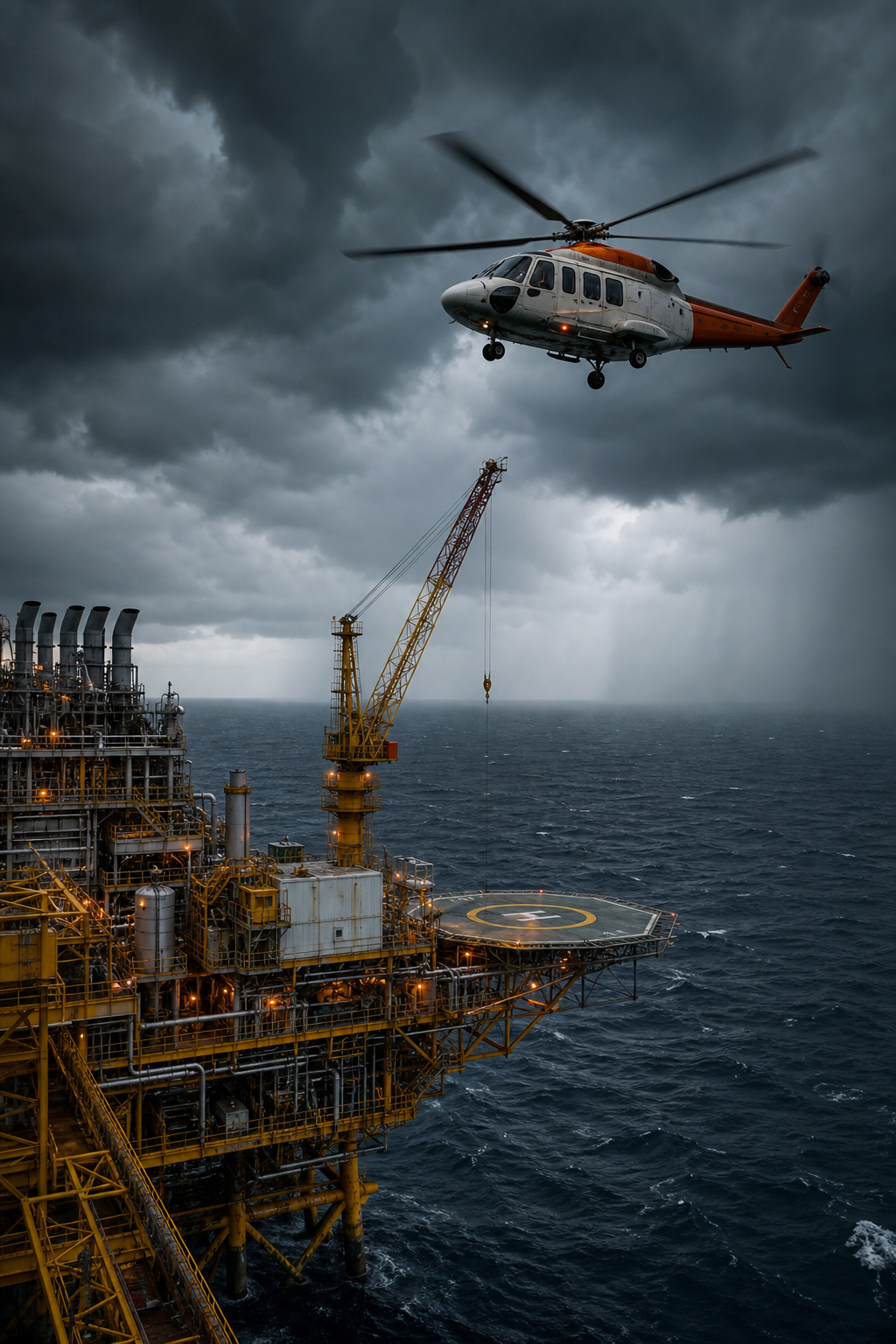
Offshore helicopter flights are a lifeline for the oil and gas industry. But when something goes wrong, the results are often catastrophic. Here's what causes these crashes, who is legally responsible, and what options victims have.
Common Causes of Offshore Helicopter Crashes
Offshore helicopter crashes are rare but deadly. , between 2021 and 2025 there were 20 accidents involving Western OEM helicopters, with 10 fatal, resulting in 27 deaths. The three most common fatal accident categories are loss of control in flight (LOC-I), controlled flight into terrain or water (CFIT), and system or component failure (SCF). These three account for nearly 80% of fatal accidents.
Pilot error is a major factor. Risky behavior, lack of training, distraction, and misjudgment can lead to LOC-I or CFIT. The environment adds risk: low altitude, poor visibility, sea spray, and sudden weather changes make flying harder. Mechanical failures also play a role. Engine problems, rotor issues, and fuel system faults can cause a sudden emergency.
As Sean Cleary Law explains, human factors like negligence and lack of training often combine with mechanical problems. A single failure may not crash the helicopter, but a chain of small errors can be deadly.
Legal Liability in Offshore Helicopter Crashes
Determining liability in an offshore helicopter crash is complex. Multiple parties may share responsibility: the helicopter operator, the manufacturer, the maintenance company, the pilot, and the oil company that contracted the flight. Maritime law governs these cases, often under the Jones Act for seamen or Death on the High Seas Act for fatalities on the high seas.
If a pilot error caused the crash, the pilot or operator may be negligent. If a part failed, the manufacturer could be liable for a defective product. If improper maintenance led to failure, the maintenance provider is responsible. Oil companies can also be liable if they pressured crews to fly in unsafe conditions.
For a deeper look at offshore injury law, see our guide on offshore injury causes and rights. An experienced maritime attorney can help identify all responsible parties and build a strong claim.
How Offshore Helicopter Crashes Are Investigated
The National Transportation Safety Board (NTSB) usually leads the investigation. They examine the wreckage, flight data recorders, maintenance logs, and pilot records. The goal is to find the probable cause and issue safety recommendations.
HeliOffshore, a global safety organization, collects data from its members and publishes annual reports. The HeliOffshore Safety Strategy aims to eliminate fatalities by addressing the most common accident types. Industry collaboration is key to improving safety.
For victims and families, an independent investigation is often necessary to preserve evidence and build a legal case. Attorneys work with aviation experts to reconstruct what happened and prove liability.
Compensation and Legal Recourse for Victims

Victims of offshore helicopter crashes may recover economic damages(medical bills, lost wages, funeral costs) and non-economic damages(pain and suffering, loss of companionship). In cases of gross negligence or defective products, punitive damages may also apply.
Law firms like Robb & Robb have recovered over $2 billion in helicopter crash cases. They note that Crash Resistant Fuel Systems (CRFS) have been available since the 1960s but many helicopters lack them, leading to devastating post-crash fires. In 2024, Robb & Robb secured a $100 million settlement for a burn victim in Nevada.
Compensation depends on the severity of injuries, the number of dependents, and the strength of the liability case. Families of those killed can file wrongful death claims. Time limits vary, but the General Aviation Revitalization Act (GARA) may bar claims against manufacturers of older aircraft.
Frequently Asked Questions
Who is liable in an offshore helicopter crash?
Liability can fall on the pilot, operator, maintenance company, manufacturer, or oil company. Maritime law under the Jones Act and Death on the High Seas Act applies. An attorney investigates to identify all responsible parties.
What compensation can families get after a fatal crash?
Families can claim economic losses (funeral costs, lost income) and non-economic damages (pain and suffering, loss of companionship). Punitive damages are possible if negligence was egregious. Settlements can reach millions, as seen in recent cases.
How long do I have to file a claim?
Time limits vary. For deaths on the high seas, a three-year statute of limitations applies under DOHSA. GARA can bar suits against manufacturers of aircraft older than 18 years. Talk to a lawyer immediately to preserve your rights.
Do I need a special lawyer for offshore helicopter crashes?
Yes. Maritime law is a specialized area. Look for an attorney with experience in offshore aviation accidents and a track record of large recoveries. Firms like maritimeattorney.ai focus on these complex cases.
What if the crash was caused by a defect?
Manufacturers can be held strictly liable for defective parts. Cases often involve engine failure, rotor issues, or fuel system flaws. An expert investigation is needed to prove the defect and that it caused the crash.
Conclusion
Offshore helicopter crashes are devastating but rare. The most common causes are loss of control, terrain collision, and system failure. Legal liability is complex, involving multiple parties under maritime law. Victims and families have options for compensation, but time is critical. If you or a loved one has been affected, contact maritimeattorney.ai for a free case evaluation. They have the expertise to handle these complex claims and fight for the compensation you deserve.